



Add Bitcoin Payment to Website: Proven Methods That Work in 2026
In this article, you will learn how to easily set up the acceptance of Bitcoin payments on your website so that you can begin using them with minimal development work or programming. It contains step-by-step instructions for setting up a Bitcoin payment gateway.


add bitcoin payment to website
Why Businesses Should Accept Cryptocurrency in 2026
If you’re running an online business in 2026, not adapting to make available cryptocurrencies like Bitcoin as an option would be considered negligence on your part. Flexibility of payment options is on the rise among your customers, and many are demanding to use crypto as their payment method. Therefore, why should this matter to you?
3 Reasons You Should Accept Cryptocurrency
- Cryptocurrency eliminates busywork. Regular payment systems can take longer and need to pay fees, as well as the middleman involved. In contrast, Bitcoin payments can either be completed quickly at a low cost or no cost at all. These are very important if your business sells worldwide or if you sell in a high-risk market and very few banks process your transactions.
- When you add Bitcoin payment to website, you reduce reliance on centralized providers. No chargebacks. Fewer frozen accounts. More predictability in your revenue flow.
- Consider adopting crypto signals into your business model. This will show your audience that you are aware that digital commerce is growing exponentially. Adding just a simple cryptocurrencies payment button to your checkout could help to build credibility with your tech-savvy consumers.
How to Add Bitcoin Payment to Website
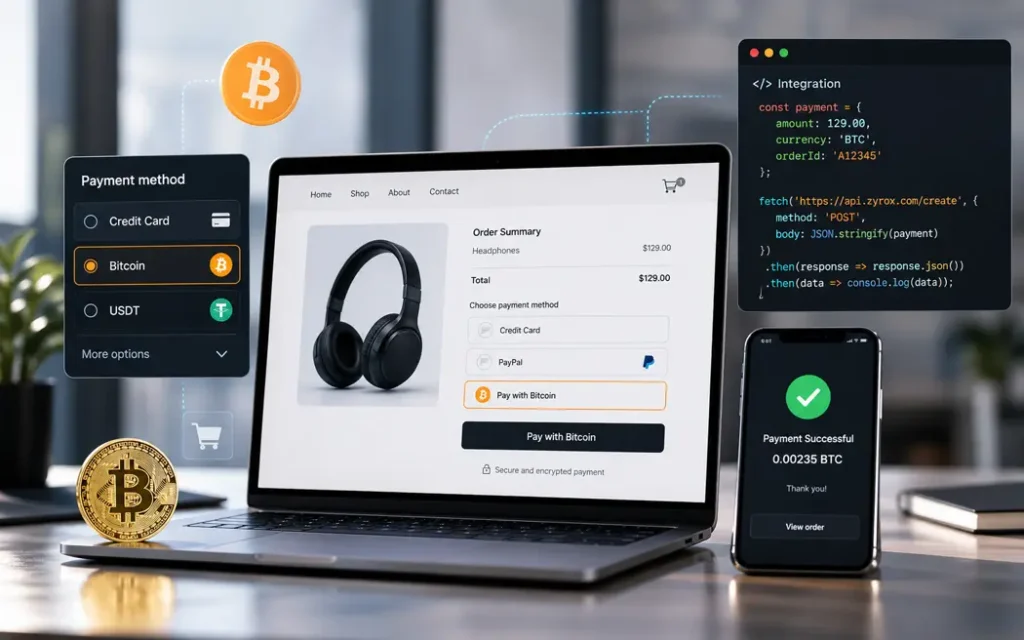
To add Bitcoin payment to website, you don’t need to build anything from scratch. Most businesses use a ready-made Bitcoin payment gateway or a CMS plugin. These tools handle wallet generation, transaction processing, and confirmations for you.
Here’s the basic flow:
- Choose a provider that lets you accept crypto payment (gateway, plugin, or API).
- Create a merchant account and connect your wallet.
- Generate a cryptocurrencies payment button or checkout link.
- Add it to your website (via HTML, plugin, or integration).
- Test a transaction and go live.
That’s it. Most of the time, you can start taking payments within an hour.
For accepting Bitcoin, using a hosted service is typically the best option. To have more control over branding, UX, and subscription integration, an API-based solution will be the best choice.
Let’s look at each method and help you choose the best one for your needs.

Main Ways to Add Bitcoin Payment to Website

1. Third-Party Bitcoin Payment Gateways
This is the most popular option for a reason. A Bitcoin payment gateway acts as an intermediary that processes transactions, manages wallets, and handles confirmations.
You can connect a payment processor provider to your website in order to accept payments easily and promptly without requiring significant amounts of code. The benefits of connecting to a payment processor provider include:
- Ease of setup; typically very little coding is involved with the process.
- Pre-built security and compliance through integration with existing systems.
- Depending on the service, coins could be automatically converted to fiat currency by the payment processor provider.
Downfalls include relying on the payment processor provider as a third party, meaning that you would not have direct access to your funds; as well as incurring transaction fees.
For many small and medium-sized businesses, utilizing the above method is also the easiest way to accept crypto payments, since they typically have no technical knowledge needed.
2. Crypto Payment Plugins (CMS-Based)
If your site runs on WordPress, Shopify, or a similar platform, plugins are the quickest path. You install, configure, and you’re ready to go.
Many plugins let you accept Bitcoin on website pages, product checkouts, or even subscriptions.
Best for:
- Content creators.
- Small eCommerce stores.
- Subscription platforms.
Limitations: Less flexibility and fewer customization options compared to APIs.
3. Custom API Integration
Selecting an advanced alternative provides the possibility of integration with your chosen service provider through their API rather than utilizing an off-the-shelf solution.
By doing this, you can have complete control over how your users will experience using Bitcoin as a method of payment.
Some benefits of doing so will be the following:
- Complete customization.
- More scalable than other options.
- Greater flexibility in terms of fees and logic.
The downside to this approach is that it will take time to develop and keep things running smoothly.
4. Direct Wallet Payments
The easiest but also the most limited way is to show the wallet address or the QR code to allow people to send you funds by hand. There is no way for people to send money through you using this method.
Advantages:
- No cost.
- Complete control.
Disadvantages:
- Doesn’t automate anything.
- Poor user experience.
- Will not scale very well.
This option works great for freelancers or specialized situations but will not work well for scalable business growth.
Comparison of Bitcoin Payment Integration Methods

| Method | Setup difficulty | Fees | Control | Best for |
| Gateway | Easy | Medium | Medium | SMBs, startups |
| Plugin | Very easy | Medium | Low | WordPress & creators |
| API integration | Hard | Low | High | Scalable platforms |
| Direct wallet | Easy | None | Low | Freelancers, small projects |
Each option solves a different problem. The key is to match the method with your growth plans—not just what feels easiest today.
Best Crypto Payment Gateways and Plugins for 2026

Popular Crypto Payment Gateways
A solid Bitcoin payment gateway should do more than just process transactions. The leading facilitator for cryptocurrency payment transactions is the cash flow generated by a Bitcoin payment gateway. It can also mitigate the effects of volatility by enabling one to convert Bitcoin into fiat currency. Below are examples of what to look for when selecting a gateway:
- Automatic conversions of Bitcoin to fiat currency with minimal delay to reduce risk with fluctuations in price.
- Support for multiple currencies, including Bitcoin (BTC), Ethereum (ETH), and stablecoins.
- Ability to hold your Bitcoin in a non-custodial wallet, thus allowing you full control and ownership of both your private keys and funds.
- Average transactional fees per gateway of 0.5%-1.5%.
- Most gateways provide access to application programming interfaces (APIs) to allow customers to implement and improve gateway functionality more easily.
Top Plugins to Accept Crypto Payment
Plugins on your CMS-based website will save you hours of setting things up. You can accept crypto payments right on the product pages, checkout forms, and membership areas of your website with plugins.
Most plugins today will have the following features:
- Easy to install and set up.
- Built-in integration support with WooCommerce or other similar platforms.
- Automatically create invoices.
- Have embedded cryptocurrency payment button options.
- Basic analytic and transaction tracking features.
If you want to accept Bitcoin on your website without having to do any coding, then plugins are a great solution for you as well. There are trade-offs with using plugins too. Being limited by the way they’re designed means that you can’t scale much higher than what basic functionality provides you. So, if you’re planning on building a custom platform or marketplace from scratch, then you’re most likely going to outgrow using plugins.
“The conversation around crypto cross-border payments and blockchain cross-border payments has shifted from theory to utility. The demand for cheaper, faster, and more flexible international transfers already exists.” – XT.com
How to Choose the Right Provider

Before you commit, ask yourself a few simple questions:
- Do you need full control or quick setup?
- Would you prefer to have cryptocurrency in your possession, or would you prefer to convert immediately?
- Do you have a global customer base, or are you servicing local customers?
If your objective is to do things quickly, then look at plugins or hosted gateways as a method. But if scalability is what you are looking for, then select a company that has a good, strong API.
Step-by-Step Guide: How to Add Bitcoin Payment to Website

Step 1: Choose Your Payment Provider
Start by selecting a provider that matches your goals. If you want simplicity, go with a hosted Bitcoin payment gateway. And if you need flexibility, look for API-first solutions.
At this stage, don’t overthink it. You can always upgrade later.
Step 2: Create a Merchant Account
When you select a payment processor, you’ll create your merchant profile in order to establish your account. This process usually requires you to accomplish a few simple tasks.
- Verify your email address.
- Connect your wallet.
- Fill out your business’s basic information.
There are also many platforms that require some sort of KYC process for those who want to convert from fiat or traditional currencies.
Step 3: Generate a Cryptocurrencies Payment Button
Most providers will let you create a cryptocurrencies payment button or checkout link in just a few clicks.
You can customize:
- Payment amount.
- Currency (BTC or others).
- Button design and label.
This button is what your users will click to pay with Bitcoin.

Step 4: Integrate the Button into Your Website
You typically get a small HTML snippet or plugin integration. Add it to:
- Product pages.
- Checkout sections.
- Landing pages.
If you’re using WordPress or Shopify, this step takes minutes. With APIs, it may take longer but gives you full control.
Step 5: Test Transactions
It’s important to test several transactions before your planned go-live date. So, it’s up to you how many test transactions you’ll want to complete. But there are certain things that should always be tested. Testing lets you verify:
- How long it takes from initiating a transaction until the transaction is confirmed.
- What the end-user will experience on both desktop and mobile platforms.
- How long it takes for the payment status to update after a transaction has been completed.
You should complete these types of tests prior to the launch of your deployment to identify or resolve small issues before they become issues for the end-user.
Step 6: Go Live and Optimize
After successfully implementing everything, you should proceed to enable live transactions and accept digital currency. This next step will provide your e-commerce business with numerous opportunities for improvement by focusing on the following items:
- Streamline checkout process.
- Reduce friction.
- Track conversion rates.
Mini Calculation: How Much Can You Save?

Let’s put numbers behind the decision.
- Traditional payment fees: ~2.9% + $0.30 per transaction.
- Crypto gateway fees: ~1% average.
If your monthly revenue is $10,000:
- Traditional fees ≈ $320.
- Crypto fees ≈ $100.
Estimated savings: $220/month or $2,640/year.
That’s not a small margin. And it scales as your business grows.
Adding Bitcoin payments isn’t complicated anymore. The real advantage comes from how you implement it and how well it fits your business model.
Integrate Crypto Payments to Suit Your Brand

At this point, you can already accept crypto. But here’s where most businesses hit a ceiling—they use generic solutions and ignore the user experience. That’s a mistake.
Payments are part of your product. If the flow feels clunky or disconnected, users hesitate. Even worse, they drop off. So instead of just embedding a tool, you should think about how crypto payments fit into your brand. A clean, well-designed checkout builds trust. A confusing one kills conversions.
Why Branding Matters in Crypto Payments
When users pay with Bitcoin, they usually check everything to be certain before they proceed, because transactions using cryptocurrency are generally not able to be reversed; thus, trust is extremely important.
That means:
- Clear instructions on how to pay.
- Consistent user interface design with your brand.
- Clear and easily understandable pricing and confirmation.
Little details can also assist you in achieving better conversion rates.
White-Label vs Generic Solutions
Standard checkout pages provided by most gateways will function but will not be unique. A white-label solution will allow you to:
- complete customize the entire payment process;
- eliminate any third-party branding;
- create an effortless user experience.
Therefore, if you are looking to really accept bitcoin and develop a long-term relationship based on trust, this level of customization is crucial to your success.
Flexible Monetization Models
Crypto isn’t just about one-time payments. Depending on your platform, you might need the following:
- Subscriptions.
- Pay-per-view content.
- Donations or tips.
- Marketplace transactions.
A rigid system won’t support this. That’s why many businesses move beyond basic plugins once they start scaling.
How to Accept Bitcoin on Website: Key Features to Compare in Crypto Payment Solutions

| Feature | Why it matters | Must-have |
| Auto conversion | Protects against volatility | Yes |
| Multi-currency | Expands customer base | Yes |
| API access | Enables customization | Optional |
| Transparent fees | Helps control costs | Yes |
| UX/UI quality | Impacts conversion rates | Yes |
At this stage, you’re no longer just adding a feature—you’re shaping how users interact with your business. And that’s where the real competitive edge comes from.
Scrile Connect: A Smarter Way to Accept Crypto Payments

If you’re looking beyond basic integrations, this is where platforms like Scrile Connect come into play. Unlike generic gateways, Scrile Connect gives you:
- Total control of their branding (white label).
- The ability to provide subscription services, as well as one-time purchases, tips, etc.
- A scalable infrastructure that will be able to grow along with your business.
Scrile Connect has been designed based on the needs of companies that are looking to offer something other than a standard gateway to their clients while also providing integrated solutions for their clients.
Zyrox System Integration
Another advantage of using the Scrile Connect platform is its integration with the Zyrox platform, which offers the following:
- A ready-to-use cryptocurrency payment system.
- A safe and secure transaction processing environment.
- A simple onboarding and training procedure so that you can really hit the ground running when accepting cryptocurrency.
If you’re serious about scaling with crypto, don’t settle for plug-and-play limitations. Scrile Connect gives you the tools to launch faster, customize deeper, and grow without friction—especially with ready-made Zyrox integration already in place.
FAQ: Add Bitcoin Payment to Website
How do I create a Bitcoin payment link for my website?
A Bitcoin payment link is basically a pre-created payment page with a set value or bill. Many crypto payments providers allow you to create links in their dashboard. You set:
- Amount of payment
- Currency (BTC or other)
- Product or order ID
The created link will be unique and can be displayed with a cryptocurrency payment button on your landing pages, emails, and social media.
Is it safe to accept Bitcoin payments on a website?
Cryptocurrency payment systems can be safe if you set them up correctly. Using a reputable provider helps protect you from handling sensitive wallet data manually.
Most modern systems offer:
- Encrypted transactions
- Fraud protection
- Wallet infrastructure security
The biggest risks usually come from human error, which is why many businesses prefer managed (outsourced) solutions instead of building everything in-house.
Do I need technical skills to add Bitcoin payment to a website?
Not really. Many modern tools are designed for ease of use, and no technical background is required. If you use plugins or hosted solutions, setup typically involves just a few configuration steps.
However, if you want full control over the payment experience or need custom branding, a developer may be required for API integration.
Most businesses start with simple solutions and move to more advanced setups as they grow.
Can I accept Bitcoin and automatically convert it to fiat currency?
Yes. Many cryptocurrency payment processors offer automatic conversion to fiat currency and transfer funds directly to your bank account.
This approach helps reduce exposure to price volatility and simplifies financial management.
What is the best way for creators to accept crypto payments?
Creators should use solutions that are easy to integrate and require minimal ongoing maintenance. Most opt for ready-made platforms or plugins that support multiple monetization models.
The goal is to provide a seamless experience for users while enabling creators to monetize efficiently. A smooth payment flow typically leads to higher conversion rates.

